
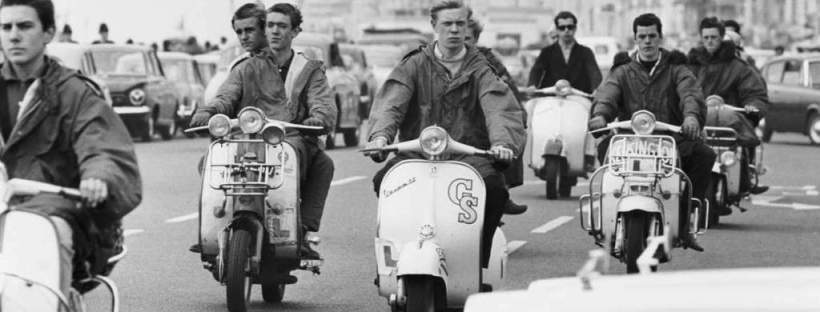
The Birth of Mods
The youth culture of ‘Mods’ first began to emerge in the 1950s, with a rival youth culture of ‘Rockers’ also emerging during this time. The Mods appeared in an affluent post-war Britain where the youth found themselves having a disposable income and desiring a sense of importance and belonging.
That sense of importance and belonging came in the form of the Mod movement. Their identity was easily recognisable due to the fashion style that they adopted. Sporting Italian and French slim-fit suits, they took great pride in their appearance and constantly ensured they had slick hair dos. The most symbolic item of clothing is arguably the fishtail parker which was more often than not worn as a protective layer over the top of suits when riding their Lambrettas. Although their style ultimately defined them as a Mod, it was about more than just looking smart. They wanted to put a barrier between their life and the life of their parents – and this was reflected in the way that they chose to dress. They didn’t want to be the same as everyone else, they wanted to stand out from the crowd and be different.
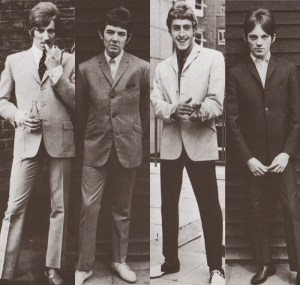
Typical Mod attire.
“I don’t wanna be the same as everybody else. That’s why I became a Mod, see? I mean you gotta be somebody, ain’t ya?” Jimmy Cooper, Quadrophenia, 1979.
The Influence of Music on Mods
It wasn’t just the fashion that defined the identity of Mods, it was the music as well. It was never a case of fashion being more important than the music and vice versa, it was how the two components worked together to create the identity of being a Mod. The image surrounding the subculture itself became increasingly more important and in turn this paved the way for artists and bands.
The Who debatably had the biggest impact on the Mod movement and were the first highly influential band to appear at this time. Crashing onto the scene in 1964, their music massively influenced the Mod culture. Their biggest impact was the release of the film Quadrophenia by their record label in 1979. Quadrophenia was centred around the famous Brighton clash between the Mods and Rockers and backed up by a The Who only soundtrack.
The Jam, a band formed in 1972 by Mod icon Paul Weller, also left a huge impression on the subculture. Although their debut album ‘In the City’ did feature in the charts, it never became mainstream and this fit in perfectly with what Mods stood for. For them, it was never about being mainstream it was about standing out and being noticed and The Jam did exactly that.
The Brighton Riots
The Brighton Riots took place in 1964 and are still considered to be one of the biggest youth culture rivalries to ever exist. On the weekend of the 16th-18th of May 1964, over 1,000 Mods and Rockers clashed on Brighton pier. Over the course of the weekend, there were 76 arrests. The rivalry between the two youth cultures wasn’t just a clash of fashion or music taste, though, it was a clash of beliefs. Both subcultures wanted to rebel against societal norms and values, but the only way to do that was to first rebel against each other.
Quadrophenia
The film Quadrophenia came out at a time when the Mod culture had just undergone a huge revival thanks to bands such as The Jam, The Kinks and The Who. It was massively important because it highlighted the deep-rooted issues that existed within society.
It showed how the youth of Britain felt oppressed because of the expectations that society held at the time. It was expected that young people should stay in their lane, work a 9-5 job and do as they’re told but Quadrophenia demonstrated how Mods, in particular a character called Jimmy Cooper, rebelled against this idea. Jimmy actively sought a life of thrills and showed that it was okay to be different and stray away from normality. Throughout the film, you see how both the Mods and Rockers wanted to break the rules and express themselves because of how oppressed they felt. This was not just reflected in their music taste or fashion sense, but also in their behavior. They took drugs, drank a lot, partied hard, vandalized buildings, got into fights and caused trouble within their community.
“Struggling to escape the oppressiveness of morals, family obligations and strict discipline in schools and on the streets, a string of youth subcultures emerged as a way of rebellion and self-expression… in the middle lie the Mods, an immeasurably large and widespread cult of fashion-worshipping working class teens with money in their pockets and time on their hands.” (Casburn, n.d.)
Stanley Cohen’s Moral Panic
Stanley Cohen was the first to address the rivalry between the Mods and Rockers in a book titled ‘Folk Devils and Moral Panics: The Creation of Mods and Rockers.’
“…a condition, episode, person or group of persons emerges to become a threat to societal values and interests; its nature is presented in a stylised and stereotypical fashion by the mass media…”
In the case of the Mods and Rockers, the media created a moral panic because the two youth cultures had ideas and beliefs that were potentially damaging towards society. They didn’t conform to what society expected of them and this led to the media portraying them in a negative and damaging way purely because they were different.
For old school mods, it was always the case of wanting to marginalize themselves from society as a way of escaping the oppressive lifestyle that they were faced with. The music that they listened to and the fashion sense that they acquired formed the subcultural identity of Mods. It has been said that it is what we consume that forms our identity and it is blatantly obvious that this is the case for Mods. Although Mod culture does still exist today, it does not exist for the same reasons. Today, Mod culture is more about nostalgia than marginalization.

 tapedecksick.music.blog